
The Kindling Draft
On what copying your own draft teaches you that editing it in place never will

Somewhere in the middle of writing my novel, there came a morning when the page refused me. Not dramatically. Just quietly, the cursor blinking, the previous session’s work sitting there on the screen, sealed off and complete, the next sentence already somewhere I could not follow.
The advice had arrived dozens of times by then, first in the MFA program and again in the writing manuals that followed. Copy the writers you admire. Transcribe their sentences by hand until you feel how they move. The advice is sound. For some writers, it has changed the way they draft and revise entirely. I had never been one of them.
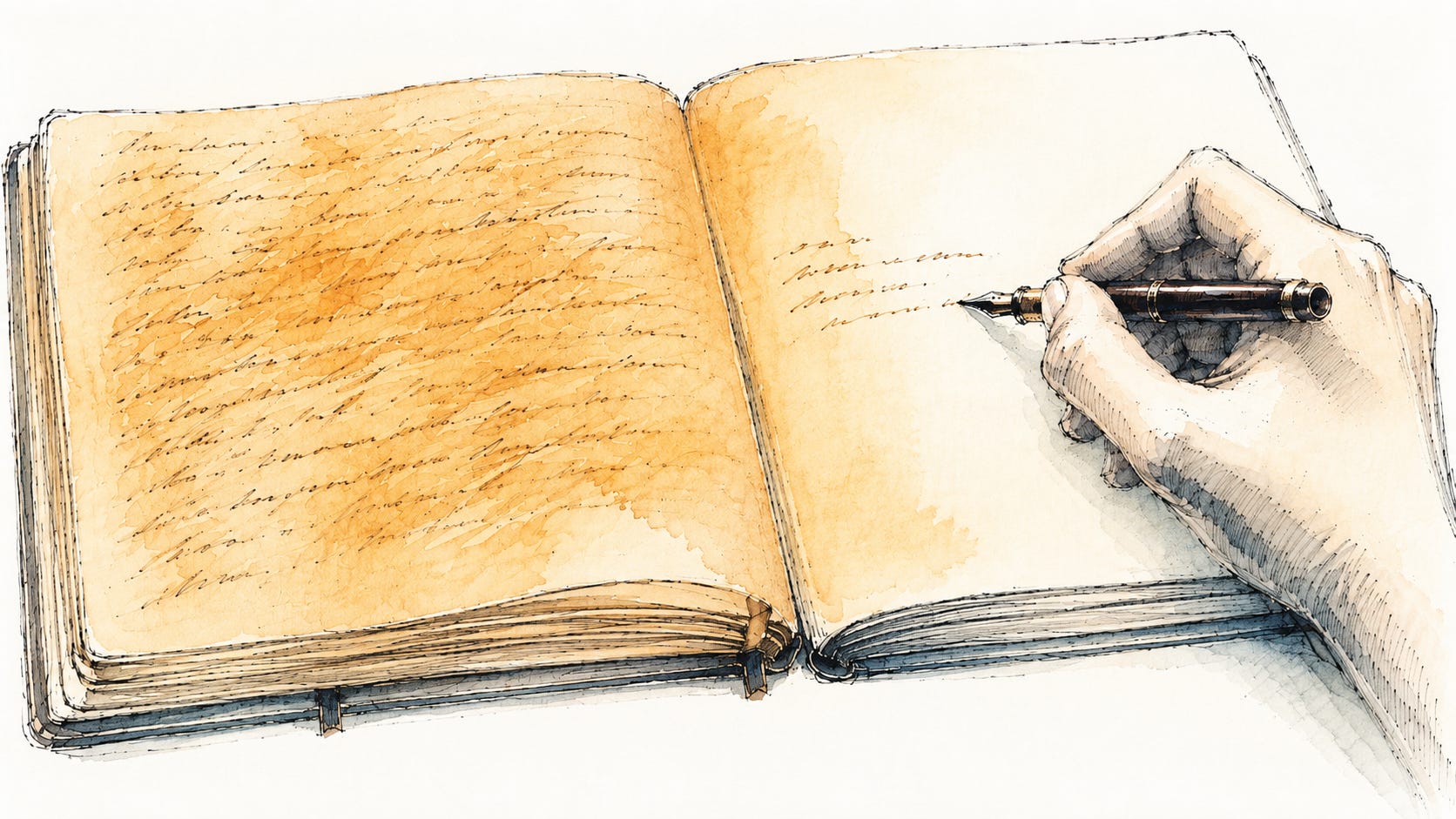
Over years of reading and curating passages and lines from writers I admired, my eclectic collection grew and bloomed into a garden of inspiration I often returned to meander through, not transcriptions exactly but quotations worth returning to when the writing needed reminding of what it was there to evoke, achieve, or become. That practice worked for me in ways the copying advice never could have, even had I tried it. Of that I am certain. But on that particular morning, with progress on a scene stalled and the cup of Number 2 yellow pencils crying out to be sorted through, I tried something different.
I picked up a pen and copied out the last few paragraphs written the day before.
Not to fix them. Not to revise. Just to move through them again by hand, slowly, sentence by sentence, the way a musician might play back a passage to find where the rhythm had gone.
By the time I finished copying, the next sentence had arrived. I had not thought my way to it. Moving through my own prose again, sentence by sentence, had loosened something that sitting and staring at the screen had only tightened. The copying had been kindling. And kindling is different from fuel. Fuel powers the fire that is already going. Kindling starts the one that is not.
Morton Feldman, the composer, once said that the most important advice anyone had ever given him came from John Cage, who told him that after you write a little you should stop and copy it, because while you are copying you are thinking about it, and the thinking gives you other ideas. Feldman built a practice around that single observation, and described what it taught him the way a writer might describe finding, late in life, the approach they had been circling for years. He called it marvelous.
What Cage understood, and what Feldman’s practice demonstrated, is that copying is not passive. It is a form of deliberate attention, a way of moving through material slowly enough that the mind has time to hear what the material is actually doing rather than what you thought you were doing when you wrote it. Walter Mosley, who is blunt about almost everything, puts the underlying principle plainly. Writing is rewriting. The first draft is the beginning of the idea, not the idea itself. What looks like a finished paragraph when you close the document at the end of a session is, in fact, an argument still waiting to be made.
The standard response to this is to open the document again and begin editing, the cursor moving through the existing sentences, adjusting a word here and a clause there, the whole document slowly improving. But editing in place keeps you inside the draft’s original logic. You are seeing what you meant to say, not what you said. Copying your own prose breaks that spell. When you have to put each sentence down again by hand, you cannot coast on familiarity. Every word has to earn its place again.
Through both the novel and the novella, I kept this practice, available without being habitual, close at hand for the mornings when the idea waited to be captured but the words refused to come. When the work was moving well, I left it alone. But when the work hit a wall, when the next scene would not come and the pages from the previous session felt remote and inaccessible, copying them by hand returned me to the work from the inside. Not from the outside looking in, which is where revision tends to put you, but from inside the voice itself, moving through it again, sentence by sentence, until the voice found its next thing to say.
It did not have to produce anything immediately. Sometimes I copied a page and the new writing came. Sometimes I copied a page and nothing came, and the notebook closed on an open question, and the next morning the page was warmer than before. Either way, that day’s writing session was not wasted. The work of the session was not the pages it produced but the understanding it returned, sentence by sentence, of what the draft was already trying to become.
Open whatever you are working on and find the paragraph that feels finished but cold, the one that closes in rather than breathes. Copy it out by hand, not to improve it and not to revise it, just to move through it again slowly, sentence by sentence, re-committing to each word as you go. You will notice, about halfway through, that some sentences copy easily and some do not. The ones that resist you are the ones that have not yet said what they mean, the idea still larger than the language you gave it. Stay with those. The session does not need to produce new pages. It needs to return you to the voice. The new writing, when it comes, will come from there.
R.A.R.
If Ramos On Craft is finding you where you are in your writing life, the novels are where these ideas live at their fullest. Three Mangoes for Hemingway: A Road Trip Novel is available now on Amazon, and Searching for Margarito Temprana: A Barcelona Novella of Scent and Stone is available wherever books are sold. And if you know a writer who would find this useful, send Ramos On Craft their way.
Find the paragraph in your current draft that feels finished but closed. Copy it out by hand. The sentence that resists you is the one that has not yet said what it means.
If Ramos On Craft is finding you where you are in your writing life, share it with a writer who needs it. And if you are not yet a subscriber, the full archive is waiting for you at ramosoncraft.substack.com.